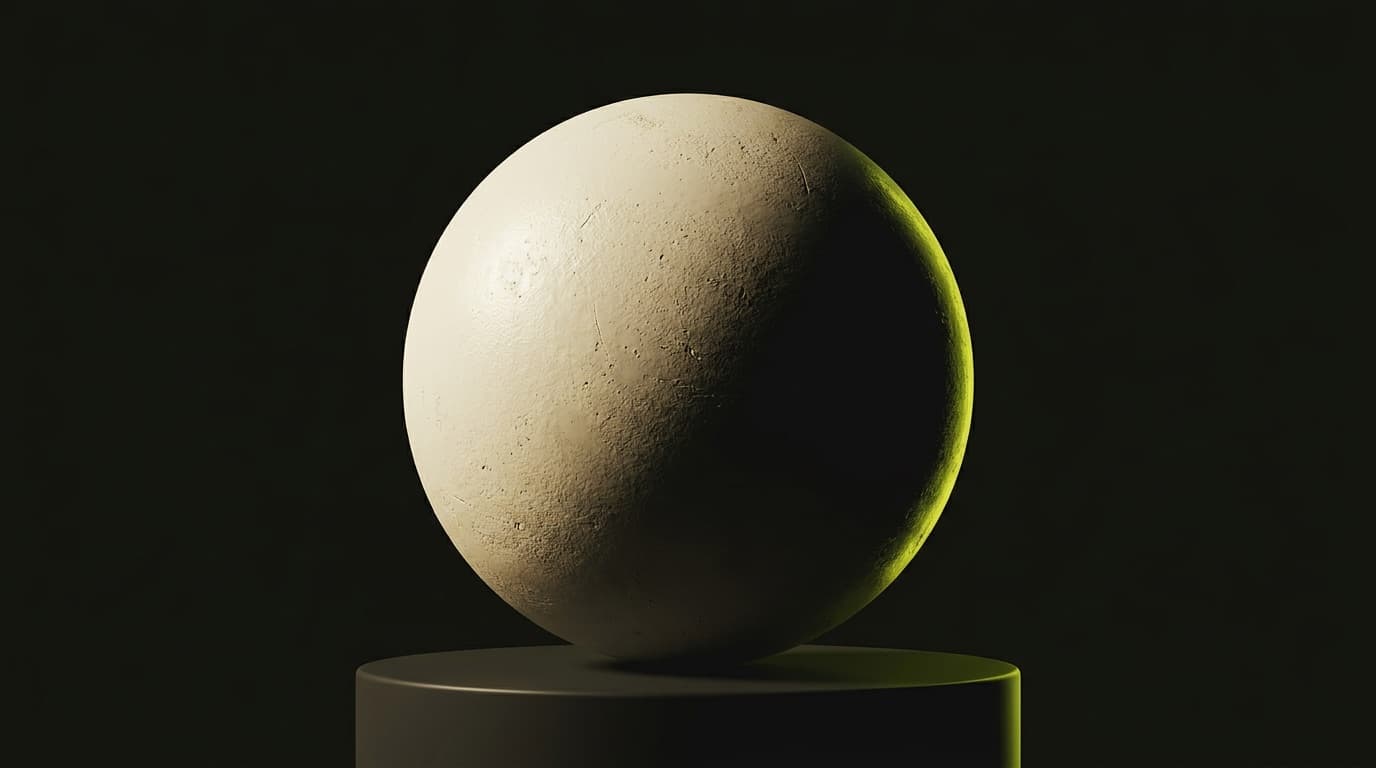
Ask most people what makes a render look fake and they'll say 'it's too perfect'. They're right, and being right about it is a complete technical brief. My lighting-and-texture study was built around three kinds of controlled imperfection, and they apply to any render, in any engine.
Light needs a history
Real light has bounced off things before it reaches your subject: it carries color from a wall, softness from a window, direction from a sun that isn't in frame. CG light, by default, comes from nowhere and carries nothing. The single biggest realism upgrade is motivating every light, deciding what it is and where it's been, before touching intensity sliders.
In practice that means fewer lights with more intention. My final study scenes rarely use more than three sources, but each one has a story the viewer never consciously reads.
Surfaces are biographies
No real object is uniformly anything. Edges wear, corners collect dust, fingerprints live where fingers go. Roughness variation, not diffuse color, is where materials come alive, because it changes how light behaves across the surface. A 'perfect' material setting is a confession that nobody ever touched the object.
I build materials in layers of history: base finish, manufacturing variance, then use. Even sci-fi surfaces obey this; the fiction is in the design, not in the physics.
The camera lies too
Real footage passes through glass, and glass is imperfect: subtle distortion, chromatic fringing at contrast edges, bloom on highlights, grain in shadows. A render that skips these is an image no camera could have taken, and the eye, trained on a lifetime of photographs, quietly rejects it. The last five percent of realism is applied in post, imitating a machine's flaws rather than nature's.

Digital Marketing Specialist, UI/UX designer and CGI artist in Istanbul, building viral brand campaigns where data-driven strategy meets cinematic 3D.