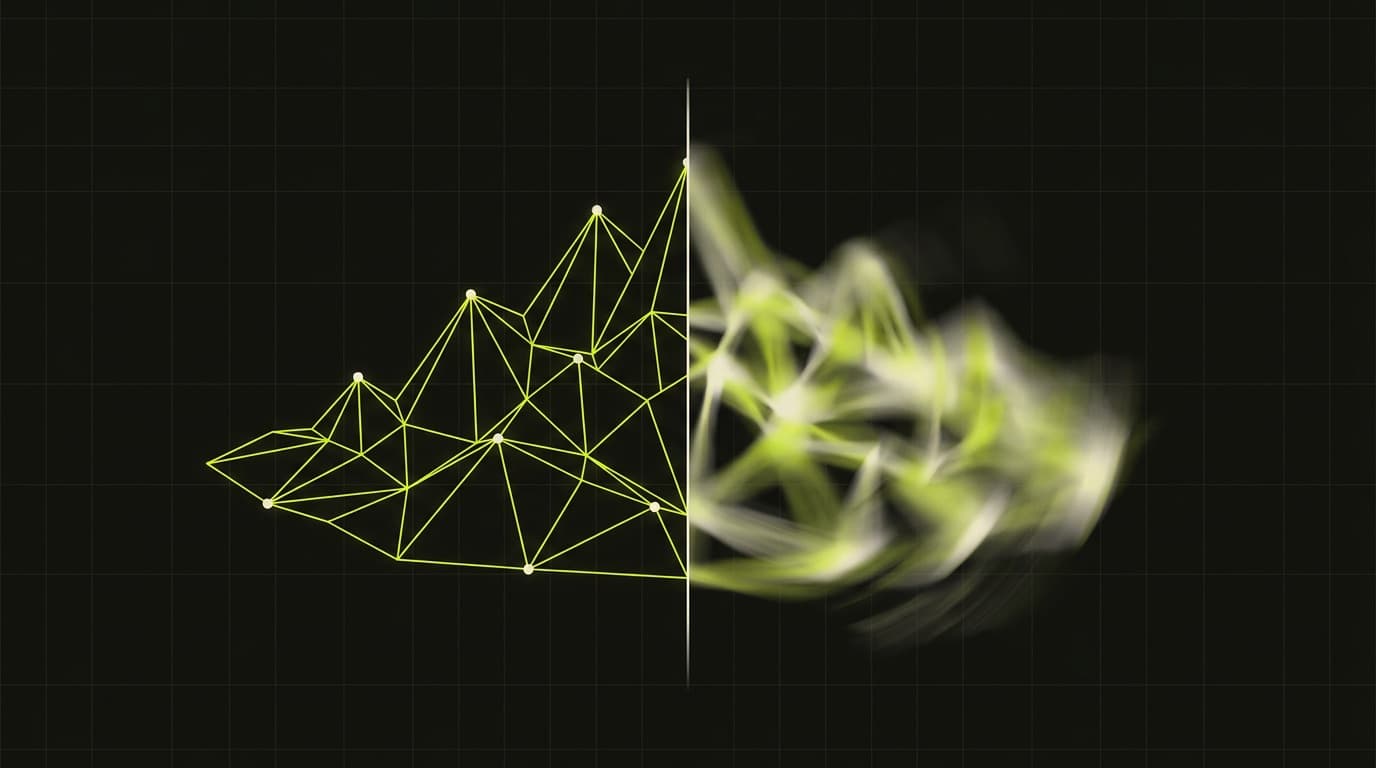
The question clients ask me most in 2026 isn't 'can you make this?' but 'can't AI just make this?'. Fair question. Sometimes the answer is yes, and saying so builds more trust than defending my render farm. Here's the decision framework I actually use, stripped of both hype and cope.
Where generative video wins outright
Speed-to-first-image is not a contest. For social content with a 48-hour turnaround, atmospheric b-roll, or testing whether a visual direction resonates before committing budget, generative tools win, full stop. They're also unbeatable for the impossible-to-shoot: abstract transitions, dream logic, styles that would take a matte painting department a month.
There's a subtler win too: volume. Feed-native marketing runs on variation, and generating twelve versions of a concept to A/B test costs almost nothing. My marketing clients get measurably better results from ten decent variants than from one perfect film. That's not an aesthetic judgment, it's what the numbers say.
Where traditional 3D is still untouchable
Control, repeatability, and ownership. A product render has to match the CAD file, the brand color, and the art director's mood, simultaneously, and again next quarter for the holiday version. A 3D scene delivers that; a prompt negotiates with you. Physics is the other moat: real simulation (destruction, fluids, cloth) carries a weight that generated motion still approximates but doesn't earn. Audiences can't articulate the difference, but they feel it.
And there's the unglamorous one: legal. Enterprise clients increasingly ask where every frame came from. 'I modeled it' is a one-sentence answer. Provenance questions around generated assets are getting resolved, but in 2026 they still add friction exactly where budgets are biggest.
The real skill is the cut between them
The industry has quietly settled the debate: studios now run hybrid pipelines as the default, with senior artists on hero assets while generative tools produce secondary content; some are even hiring for roles like 'generative output quality supervisor'. My destruction film is hand-directed simulation; some of its early previz was generated in an afternoon. The audience never needs to know which frames began where. They just feel whether the piece is coherent. That's the actual craft now: not choosing a side, but making the seam invisible.
If you're commissioning work, the honest translation is this: generative for velocity and exploration, 3D for precision and repetition, and a director who knows both for anything with your name on it.
The cost math, made concrete
Strip away opinion and run the numbers on a real brief: a 15-second product-centric social spot. The generative route: a day of prompting and curation, a day of cleanup and grading. Call it two working days, near-zero render cost, and a result whose product geometry is approximately right. The traditional route of modelling from CAD, look-dev, animation, simulation, lighting and rendering runs eight to twelve working days on a solo pipeline, plus render time, and a result that is exactly right and infinitely revisable.
Which is correct depends entirely on what 'approximately right' costs the client. For a trend-jacking post that lives eighteen hours in a feed, approximate is free money. For the hero asset of a product launch that legal, brand and three VPs will inspect frame by frame, approximate is a liability with a two-day fuse. The professional's job is diagnosing which brief is which before quoting, then saying so out loud.
What I'm watching for next
The gap that matters isn't image quality anymore. It's persistence. The moment generative systems can hold a product's exact geometry, materials and brand color stable across shots and revisions, the economics above collapse and get rewritten. Studio pipelines are already hedging: the hybrid workflows and new supervision roles emerging across the industry this year are essentially bets that the seam between generated and simulated content will keep needing human management for a while yet.
My own hedge is simpler: I invest in the skills that survive either outcome. Composition, lighting logic, motion taste and client diagnosis transfer completely regardless of which renderer produces the pixels, neural or physical. Tools have never been the moat. The eye is.
Digital Marketing Specialist, UI/UX designer and CGI artist in Istanbul, building viral brand campaigns where data-driven strategy meets cinematic 3D.